A+A 2025

INTEGRATING REAL-TIME WEARABLES + CLOUD-BASED ANALYTICS

Control your occupational health risks with integrated workplace wearables and cloud-based analytics from Trolex and Ideagen Reactec’s connected solutions.

Error: Contact form not found.

Connected solutions

Simplify your workplace health and safety with Ideagen Reactec’s R-Link wearable watch and our XD1+ Personal Dust Monitor. Connect R-Link with XD1+ to visualise all dust data in real-time, alongside HAV, noise and other hazards and manage your workplace risks in one centralised cloud-based platform. Enable quick action to reduce risk, whilst engaging with your health and safety management, whether it be dust, noise or HAV risk.

WORKPLACE WEARABLES

Image of TX8061 XD1+ Personal Dust Monitor
TX8061 XD1+ Personal Dust Monitor

Image of Reactec Ecosystem
Reactec Ecosystem

Image of AIR X Software
AIR X Software

Image of Particulate Monitoring
Particulate Monitoring

PRODUCT SALES ENQUIRIES

AIR X
PARTICULATE
MONITORING

The benefits AIR X real-time monitoring technology brings to your workplace safety.

THE CHALLENGES.

Icon.
No instant visibility

Businesses cannot act before occupational environments become too dangerous to the workforce
Icon.
Delayed results

Traditional testing methods only reveal over exposure after risks to workers has occurred
Icon.
Reputational damage

Missed exposure data can lead to fines, stoppages, reputational damage + occupational ill health

REAL-TIME. REAL RESULTS.

Icon.
See the bigger picture

Pinpoint processes that cause the highest spikes in exposure risks to your workers during shifts and learn how best to mitigate these
Icon.
Improve business operations

Optimise working patterns, processes and ventilation systems based on live RCS data
Icon.
Build trust

Show workers + stakeholders your commitment to your employees’ health + safety

WHY AIR X?

Icon.
Immediate data

Real-time detection of particulate exposure throughout your working shift
Icon.
Automatic records

Continuous data logging for instant records
Icon.
Immediate data

Take corrective action before exposure limits are exceeded
Icon.
Connected

Integrate with existing data access communications

PARTICULATE MONITORING

Image of TX8061 XD1+ Personal Dust Monitor
TX8061 XD1+ Personal Dust Monitor

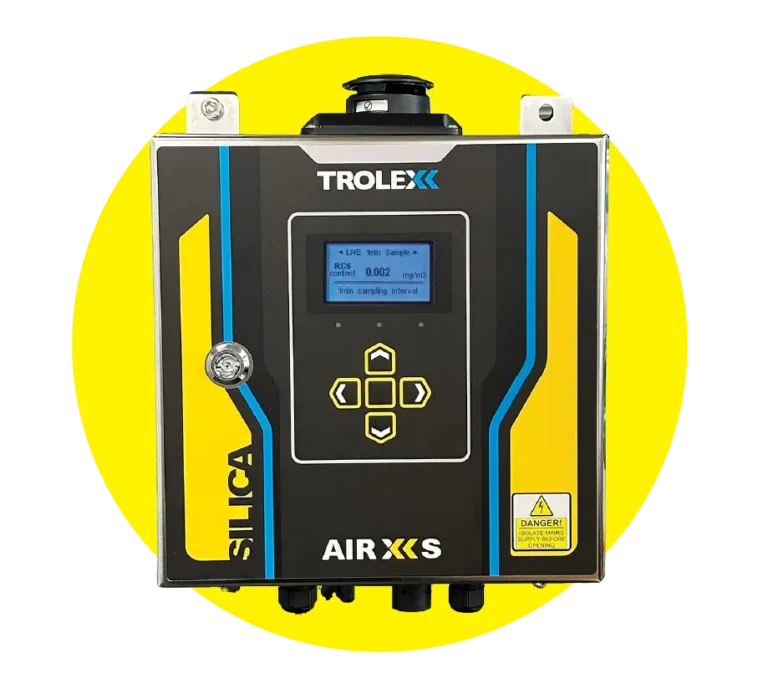
Image of TX8100 AIR XS Silica Monitor
TX8100 AIR XS Silica Monitor

Image of TX8005 AIR XD Dust Monitor
TX8005 AIR XD Dust Monitor

PRODUCT SALES ENQUIRIES

Get product updates

    You may unsubscribe from these communications at any time. For more information on how to unsubscribe, our privacy practices, and how we are committed to protecting and respecting your privacy, please review our Privacy Policy.

    5 ways AIR X software technology protects your workplace

    AIR X Software

    Knowing you have a dust problem is one thing. Being able to do something effective about the problem is another. Thanks to Trolex real-time dust monitoring technologyall the data collected can be accessed, viewed and interrogated to make vital business decisions and actively protect you and your worker’s health. Here’s 5 effective ways of using our AIR X particulate monitoring software. 

    First and foremost, the benefit of seeing dust levels in real time is being able to deduce whether you, youworkers and your occupational environments are safe. Respirable dust is smaller than 10 μm meaning its invisible to the human eye, yet its so finite that it can easily be breathed in and penetrate the lungs. You may be breathing in respirable dust and putting your respiratory health at risk without even knowing it. But with real-time dust data, you can know exactly how much dust you’re exposed to throughout your working day and introduce the necessary steps to protect your respiratory health. 

    Real-time dust data isn’t just available for live readings in real timeCompatible with all our real-time monitoring technology, our Breathe Software collects and stores data for up-to 10-years, so you can see changes in your dust levels for the entire previous decade. You can track trends in the dust levels your workers are exposed to over a period of time in your working day, week, month or year and determine whether you and your workers have been exposed to potentially hazardous substances over that period.

    Our dedicated real-time dust monitoring software allows you to personalise all the relevant settings for your Trolex real-time dust monitor. If the dust monitor is alarming you of dust levels irrelevant to your local legislative limits, it’s not necessarily going to protect you as effectively as if it’s alarming you of the dust levels in your local environment. Our Breathe software lets you set dust levels specific to your environment and workplace to ensure you’re constantly monitoring for dust levels in the most effective way possible.  

    Real-time dust data allows you to see trends in your dust levels over a set period and subsequently introduce vital control measures to effectively manage and control dust. Our dedicated Breathe Software allows you to understand at what time peak dust levels were in your working day and deduce what activities were taking place during this time, so you can introduce relevant and effective control measures to prevent future dust from becoming airborne at this time. 

    After introducing control measures, you can continue to use real-time dust data through our dedicated Breathe Software to see how effective these control measures are in controlling dust. If you can’t continually track dust levels over time, it’s impossible to know if your control measures are working effectively, which could cost money, time and most importantly harm your health and wellbeing. However, thanks to Breathe Software, you can see how dust levels are affected by introducing control measures and subsequently make vital decisions to continue to control dust exposure. 

    PARTICULATE MONITORING

    Image of TX8100 AIR XS Silica Monitor
    TX8100 AIR XS Silica Monitor

    Image of TX8061 XD1+ Personal Dust Monitor
    TX8061 XD1+ Personal Dust Monitor

    Image of TX8005 AIR XD Dust Monitor
    TX8005 AIR XD Dust Monitor

    Image of TX8060 XD ONE Portable Dust Monitor
    TX8060 XD ONE Portable Dust Monitor

    GET AIR X UPDATES

      You may unsubscribe from these communications at any time. For more information on how to unsubscribe, our privacy practices, and how we are committed to protecting and respecting your privacy, please review our Privacy Policy.

      5 industries where real-time silica monitoring is effective

      Each year thousands of construction workers contract or die from respiratory diseases from exposure to dust, including silica dust. This can be due to direct exposure on site or simply by just working nearby the construction site, e.g. in a nearby office or cabin.  

      Obviously, activities such as drilling, cutting and building generates dust, as raw materials such as brick and stone are disturbed and ground down, making fine dust become airborne, but dust also becomes a risk to workers nearby in other ways. 

      Respirable Crystalline Silica (RCS) is less than 10µm in size, meaning that it’s not only easily inhalable, but is also fine and small enough to travel far distances effecting individuals not directly located near construction activities. 

      Real-time silica monitoring with AIR XS provides transportable monitoring of respirable silica dust, with a measurement capacity of 1µm to 10µm to monitor across entire construction sites, in nearby offices and further a-field to protect everyone. 

      With the ability to monitor in real-time, workers can gauge which activities are causing certain RCS levels at specific times in the day, e.g. if cutting stone causes higher levels of RCS, to then introduce effective control measures to limit RCS generation. 

      In the UK alone, there are approximately 2.6 million manufacturing workers, working with various different materials. Approximately 20% of workers in the UK are affected by dust from stone, cement, brick or concrete across workplace processes. 

      Manufacturing processes can involve anything from welding and joinery to grinding, cutting and polishing. It can entail all different types of raw materials such as metals and plastics, as well as clay, glass and sand which can all generate dangerous RCS. 

      In manufacturing as a whole, which uses various different raw materials and often has multiple processes occurring at once, it’s important to be able to distinguish RCS from other dusts, in total dust loads and mixes, in real-time, both accurately and reliably. 

      Real-time silica monitoring with AIR XS provides detailed information by examining multiple detection parameters for RCS in real time, including size, symmetry, and a series of optical markers unique to RCS particles, in total dust loads. 


      An estimated 49.5 million miners worldwide are exposed to high concentrations of RCS during their work. Due to specific work processes, enclosed spaces and limited air quality, exposure to silica dust can have a big impact on mining and its workers. 

      Processes such as drilling and blasting of materials, even more so during demolition of entire structures, generates high levels of dust, such as silica, due to brittle underground materials such as sand and rock being regularly disturbed. 

      As well as this, due to the lack of ventilation and air quality underground, as well as the enclosed spaces which workers find themselves in, RCS can become easily inhaled, sometimes causing life-threatening respirable diseases. 

      Real-time silica monitoring with AIR XS offers workers the ability to know exactly how much silica dust they’re exposed to, live and in real-time, no matter the environment they’re in, even including in noisy, high-volume workspaces with limited visibility. 

      Real-time readings on device as well as live and historical data through BreatheXS software allows workplaces to subsequently introduce the correct and effective control measures to prevent further overexposure. 

      Exposure to silica dust in quarries is not uncommon. Highly dusty processes, with heavy-duty machinery and large-scale vehicles not only generate dust from materials but also disturb settled dust on the ground, increasing the risk.  

      Crushing, drilling and blasting of raw materials such as sand and stone can generate high levels of RCS. This dust in incredibly fine and invisible to the human eye, making it easily inhalable and airborne. 

      With the wide-open spaces of quarrying, and various different activities and processes being undertaken, this fine dust can easily spread from one area to another, increasing the risk of exposure to it and subsequent associated health risks. 

      Real-time silica monitoring with AIR XS ensures that all RCS is accurately monitored for, particularly of vast open areas of the quarry, to account for all workers who may be exposed to hazardous silica dust. 

      Thanks to the transportable capabilities of AIR XS, multiple areas, all activities and processes in a quarrying environment can be regularly monitored, allowing for effective control measures to be introduced for excess silica dust. 

      Silica is a naturally occurring mineral found in many types of rocks and stones. When working in stonemasonry, natural minerals are regularly cut into, generating high levels of RCS, exposing workers to potential lung and respirable illnesses. 

      Shaping, cutting and crafting natural and engineered stone involves chiselling, grinding and polishing of stone, which can contain up to 90% silica content. Once disturbed it often becomes airborne further increasing the risk of illness. 

      Without effective and regular control measures, suitable for the material on the job, such as wet methods and dust extraction workers may put themselves and other workers at risk. Real-time silica monitoring can help to support this. 

      Real-time silica monitoring with AIR XS provides a valuable insight to the entire workplace, which can be used for introducing the correct control measures to ensure that workers aren’t overexposed to high silica content. 

      PARTICULATE MONITORING

      Image of TX8100 AIR XS Silica Monitor
      TX8100 AIR XS Silica Monitor

      Image of TX8061 XD1+ Personal Dust Monitor
      TX8061 XD1+ Personal Dust Monitor

      Image of TX8005 AIR XD Dust Monitor
      TX8005 AIR XD Dust Monitor

      Image of TX8060 XD ONE Portable Dust Monitor
      TX8060 XD ONE Portable Dust Monitor

      GET AIR X UPDATES

        You may unsubscribe from these communications at any time. For more information on how to unsubscribe, our privacy practices, and how we are committed to protecting and respecting your privacy, please review our Privacy Policy.

        5 construction scenarios where respirable dust is generated

        Cutting + grinding materials

        Natural construction materials such as woodstone and other raw materials can generate fine, respirable dust once cut and ground into on construction sites. The use of abrasive wheels, cutters or blades from many handheld and stationary machinery removes material from workpieces, creating hazardous airborne respirable dust. 

        Demolition + scabbling

        Removing layers or entire surfaces during construction processes can pose serious risks for construction workers and other personnel. The use of heavy-machinery and mechanical tools disturb entire surfaces, leading to construction materials being destroyed into smaller, more respirable particulates, posing health concerns. 

        Mixing raw materials

        Mixing in construction often involves combining various raw components such as cement, sand and aggregates. Adding raw materials into the mixer, no matter what is being mixed, both grindand mixes materials against each other and creates high levels of airborne respirable dust, presenting health risks if not managed correctly. 

        Using heavy machinery

        Using heavy-duty vehicles on construction sites (e.g. the use of bulldozers, cranes, trucks and forklifts) generates high levels of dust. Whilst all these vehicles are involved in building and demolition on construction sites, which in turn generates respirable dust, they also carry large amount of construction materials and settled dust across workplaces, spreading the risk further. 

        Maintenance + cleaning

        When respirable dust is generated on a construction site, it can become settled across workspaces if not properly managedPoor maintenance and cleaning methods like dry sweeping often makes dormant dust can airborne again. As this dust may have been settled for a while and forgotten about, it’s often not managed effectively. 

        PARTICULATE MONITORING

        Image of TX8100 AIR XS Silica Monitor
        TX8100 AIR XS Silica Monitor

        Image of TX8061 XD1+ Personal Dust Monitor
        TX8061 XD1+ Personal Dust Monitor

        Image of TX8005 AIR XD Dust Monitor
        TX8005 AIR XD Dust Monitor

        Image of TX8060 XD ONE Portable Dust Monitor
        TX8060 XD ONE Portable Dust Monitor

        GET AIR X UPDATES

          You may unsubscribe from these communications at any time. For more information on how to unsubscribe, our privacy practices, and how we are committed to protecting and respecting your privacy, please review our Privacy Policy.

          Is your workplace adequately protected against dust?

          Hear from Adrian

          We know that there’s probably hundreds of things which need constant monitoring and checking over during your working day, and the constant safety of your workforce is likely one of the top priorities. But we’re here to help. 

          Adrian Eccles, Technical Product Manager here at Trolex, explains the most beneficial ways to know if you’re adequately protecting your employees against hazardous dusts.

          Getting an expert view

          A great place to start is utilising the services of a registered occupational hygienist. Have air monitoring undertaken on the premises to get a baseline idea of your risk environment with regard to dust and then implement the recommendations of the hygienist to start reducing your levels of exposure. 

          To support this approach and get the most from your investment in the hygienist, teams can use real-time dust monitoring technology to collect data about their workers’ exposure to risk. 

          Real-time monitoring will also notify them instantly if any alarm points are breached, which would indicate a failure in a control, or alert to a non-prescribed operating method being used by a worker.

          Supporting recommendations with real-time data

          Real-time monitoring effectively offers an extra layer of protection for the entire workplace. Rather than going into it blind, and depending on information from the hygienist, real-time monitoring supports all the work being done by the hygienist. Adrian also highlighted how personal real-time monitoring can be beneficial in a similar scenario:  

          “Personal real-time monitoring and the subsequent data has many benefits in the workplace. Not only should it be used in a multi-pronged approach to safety, but it can also be used as an educational and training tool. For example, by demonstrating best practices to workers, they can better understand how a subtle change in the way they complete a task can have a major impact on their exposure to risk from dust. 

          Real-time monitoring can highlight a worker who isn’t following the assigned procedure and is putting themselves and any others in the area at risk from dangerous levels of dust. And when information or alerts are displayed immediately on a screen, this adds real power to training efforts.” 

          A more personal approach

          Adrian also highlighted how important personal real-time monitoring can be, when engaging workers with the benefits of real-time data. If workers can see, in real-time, the dust levels they’re directly exposed to, not only do they know their workplace is taking care of them, but it’s also much more valuable than just being told ‘you’re at risk of hazardous dust exposure’ without any significant information or data to back it up. Adrian said: 

          “Personal, real-time monitoring gives confidence to workers that they’re being protected and that their employer is taking their health seriously. An organisations’ staff are their biggest asset, and this technology helps ensure that they’re being kept safe from harmful dust levels. 

          By keeping your employees safer, you’re also helping to protect your organisation by reducing the likelihood of negligence claims or breaches of safety legislation (and the cost implications and negative publicity that often come along with it).” 

          Accessible data for aligning the workforce

          And it’s not just worker satisfaction and compliance, which adequately protecting your workforce through real-time monitoring can provide, as Adrian demonstrates:  

          “This real-time technology has been proven to lower costs for the businesses who implement it: at a car manufacturing plant in Europe, for example, real-time dust monitoring technology revealed that extractors were running too fast. 

          When they lowered the speed of the extraction units, they lowered their energy usage and costs. And at a large construction project, real-time dust monitoring technology helped regulate water suppression efforts, resulting in lower water and diesel usage, and reduced costs.” 

          So, is your workplace being adequately protected against dust? If you’re not regularly monitoring the effectiveness of your dust control measures and utilising the expertise of hygiene professionals, then you’re putting yourself and your workers at risk of hazardous dust exposure. 

          PARTICULATE MONITORING

          Image of TX8100 AIR XS Silica Monitor
          TX8100 AIR XS Silica Monitor

          Image of TX8061 XD1+ Personal Dust Monitor
          TX8061 XD1+ Personal Dust Monitor

          Image of TX8005 AIR XD Dust Monitor
          TX8005 AIR XD Dust Monitor

          Image of TX8060 XD ONE Portable Dust Monitor
          TX8060 XD ONE Portable Dust Monitor

          GET AIR X UPDATES

            You may unsubscribe from these communications at any time. For more information on how to unsubscribe, our privacy practices, and how we are committed to protecting and respecting your privacy, please review our Privacy Policy.