

"REAL TIME" MONITORING IN THE WORKPLACE
When it comes to health and safety in the workplace, real-time monitoring and real-time data is vital to managing control measures for exposure to hazardous particulates. Incorporating real-time monitoring technology allows you to see spikes in exposure, particularly at what point and exactly what processes generate more dusts, so you can do something about it.
“Real-time monitoring is instant, in the moment, meaning you can do something about a problem and implement control measures.” – said Joe Marais, Occupational Hygienist and Product Development Manager. “It allows you to try a new control measure and have a very quick indication of whether that has been successful or not in reducing the hazard.”
REAL TIME FOR REAL RISK CONTROL
When it comes to workplace health and safety, effective measures must be taken to protect workers, and real-time monitoring is the most effective way to provide this. “Real-time monitoring is a tool you can use in combination with the Hierarchy of Controls. Unfortunately, in certain circumstances like with crystalline silica, which is naturally occurring in so many materials, you can’t necessarily just eliminate it, and it can be quite difficult to substitute it.”
“So, for the most part, you will need to introduce engineering controls and that’s where real-time monitoring comes in,” When carrying out an action that generates extremely large volumes of dust, or you know for a fact you’re being exposed to dust, you can introduce water suppression or other extraction methods to the activity to reduce your exposure and have an instant indication of whether the control measures have been effective.

THE HIERARCHY OF CONTROLS
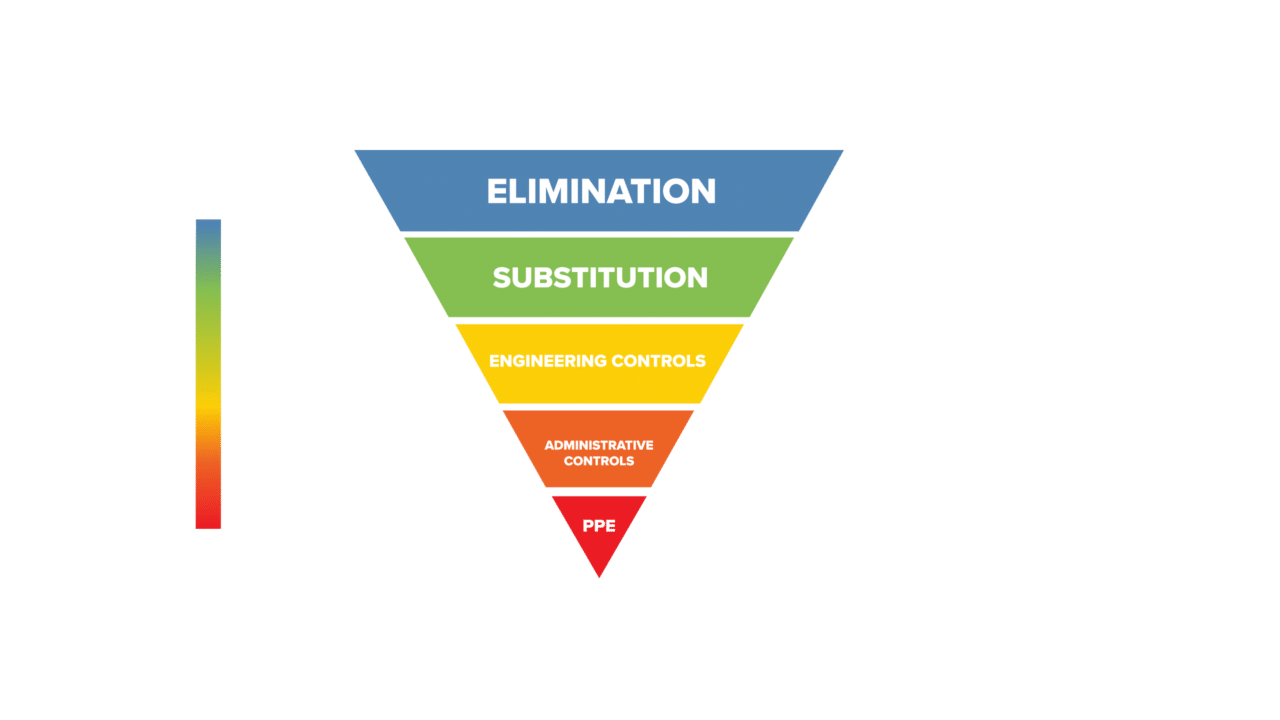
“If you’re able to incorporate real-time monitoring when applying the Hierarchy of Controls, you’ll quickly see whether what you’re doing to mitigate the risks of dust exposure is effective or not.”
“You’re able to see the exposure concentration in real-time before the control measure is introduced, then once you introduce the control measure, you can immediately see if there is a drop in the exposure concentration.”
Whilst real-time monitoring can support the decision making, implementation and surveillance of engineering controls, the effect this can have on entire workforces is also valuable. Part of the problem when it comes to introducing effective control measures is having the entire workforce understand the full extent of why it’s important to implement such measures and continue to follow the protocol surrounding it.